Thirty years on, the bomb that changed Manchester forever
Reporter: David Murphy
Date published: 14 June 2026
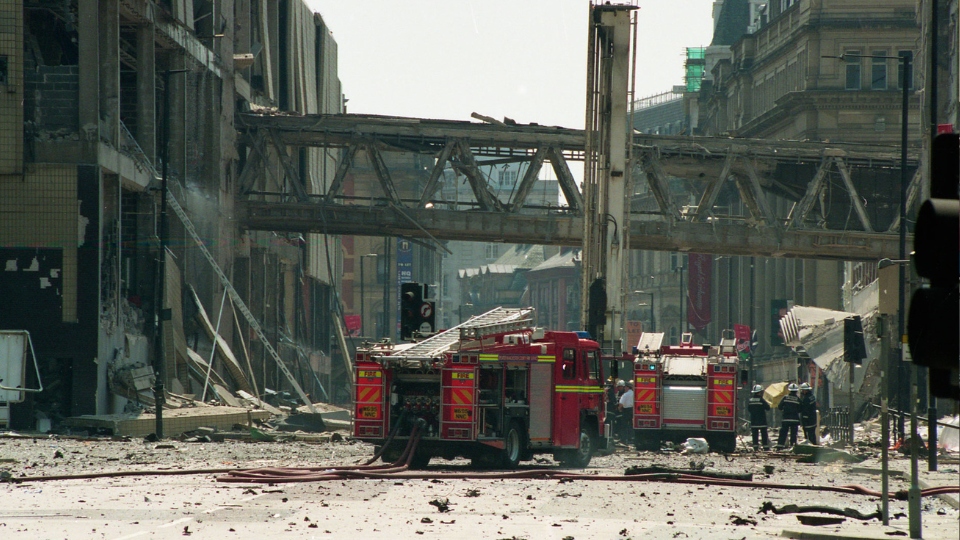
the bomb that changed Manchester forever
At 11.17am on Saturday 15 June 1996, Manchester changed forever.
A massive explosion ripped through the heart of the city centre, shattering windows half a mile away, tearing apart buildings and sending a huge cloud of dust, debris and steel high above the skyline.
More than 200 people were injured.
Remarkably, nobody was killed.
Three decades later, the 1996 Manchester bombing remains one of the most significant moments in the city's modern history. It triggered one of the largest peacetime evacuation operations ever carried out in Britain and left a lasting mark on Greater Manchester, its people and its police force.
The day had begun like any other busy Saturday.
Thousands of shoppers were filling the Arndale Centre and surrounding streets searching for summer bargains. Football supporters were making their way into the city ahead of England's Euro 96 clash with Scotland, a match that would later produce one of the tournament's most memorable moments when Paul Gascoigne scored and celebrated with the famous dentist chair routine at Wembley.
But while Manchester prepared for a day of shopping and football, events were unfolding that would soon bring the city to a standstill.
A Ford Cargo van had been parked outside Marks and Spencer on the corner of Corporation Street and Cannon Street.
A traffic warden even issued the vehicle with a parking ticket.
What nobody knew at the time was that the van contained a huge bomb.
Shortly before 10am, a warning call was received stating that an explosive device had been placed inside the vehicle.
Greater Manchester Police immediately began a major evacuation operation.
Around 80,000 people were moved away from the area in what became one of the largest evacuations in British history.
Just over an hour later, the bomb exploded.
The blast was the largest bomb detonation in the United Kingdom since the Second World War.
Corporation Street suffered devastating damage. Shop fronts were destroyed. Buildings were left buckled and broken. Debris was scattered across a huge area of the city centre.
Yet amid the destruction, one image came to symbolise Manchester's resilience.
A red post box remained standing among the wreckage.
Photographs of the post box surrounded by devastation were shared around the world and became a lasting symbol of a city determined to recover.
For many officers who responded that day, the memories remain as vivid now as they were 30 years ago.
Lee Cullen, who now works in GMP's Serious Crime Division, was a Tactical Aid Unit constable deployed in the city centre during Euro 96.
He was among the officers sent to establish and extend the security cordon after the bomb warning was received.
"We didn't know the full size of the device at the time but knew that the cordon for a device potentially of that size needed to be doubled if not trebled from what it was," he recalled.
The decision to move the cordon further back proved crucial.
When the bomb detonated, Cullen was within sight of the vehicle.
"The bright flash followed instantaneously by a huge fire ball and percussion wave is something that has lived with me to this day," he said.
"I had heard explosions before but that sound, a huge deep crump, was deafening."
As glass rained down across the city centre, officers immediately began searching damaged buildings for trapped members of the public.
Cullen remembers forcing open doors that had twisted under the force of the blast.
"The bomb had caused door frames to twist and buckle making the opening of doors almost impossible," he said.
One injured man had to be carried from a damaged office building.
"He had lost one of his shoes and blood was pouring from his face. There was that much glass on the floor that I made the decision to lift him over my shoulder and run him down to the meeting point."
Elsewhere, officers worked to clear the city centre amid fears that damaged buildings could continue shedding glass and debris.
"It was a surreal scene along Corporation Street," Cullen said.
"There were mannequins hanging out of the windows and general blast debris all over the epicentre."
The physical damage would eventually be estimated at around £700 million, making it one of the most expensive terrorist attacks in British history at the time.
Yet the bombing also became a turning point.
The rebuilding programme that followed transformed Manchester city centre, reshaping large parts of the area that millions of people now visit every year.
Many younger visitors walking through the city today have little idea how different Manchester looked before 1996.
Assistant Chief Constable Chris Sykes said the professionalism shown by emergency services on the day prevented a far greater tragedy.
"It is incredible to think we are now 30 years on since one of the force's biggest policing operations, and one of the largest evacuations in British history," he said.
"80,000 people were in the area at the time. It was supposed to be a weekend of jubilation for the country, but that Saturday took an unexpected turn that would change the look and feel of Greater Manchester forever."
He added that the actions of officers working in extremely difficult circumstances helped prevent mass casualties.
The bombing remains one of the defining events in Manchester's recent history.
Thirty years later, memories of the devastation remain strong for those who witnessed it, but so too does the memory of the city's response.
Manchester rebuilt.
It recovered.
And the resilience shown in the aftermath of that June morning continues to define the city today.
To mark the 30th anniversary, the Greater Manchester Police Museum has opened a new exhibition dedicated to the 1996 bombing. The gallery opened on 9 June and will remain open throughout 2026.
Most Viewed News Stories
- 1Oldham based business Constant Group invests £3m to accelerate growth and triple capacity
- 2Saddleworth farm opens gates to visitors for Open Farm Sunday
- 3Mahdlo Youth Zone is marking Volunteers’ Week by launching an appeal for 15 new mentors as part of...
- 4Quick thinking PCSO praised after saving man’s life in Saddleworth
- 5Young learners explore future careers at Hulme Grammar School Careers Fair