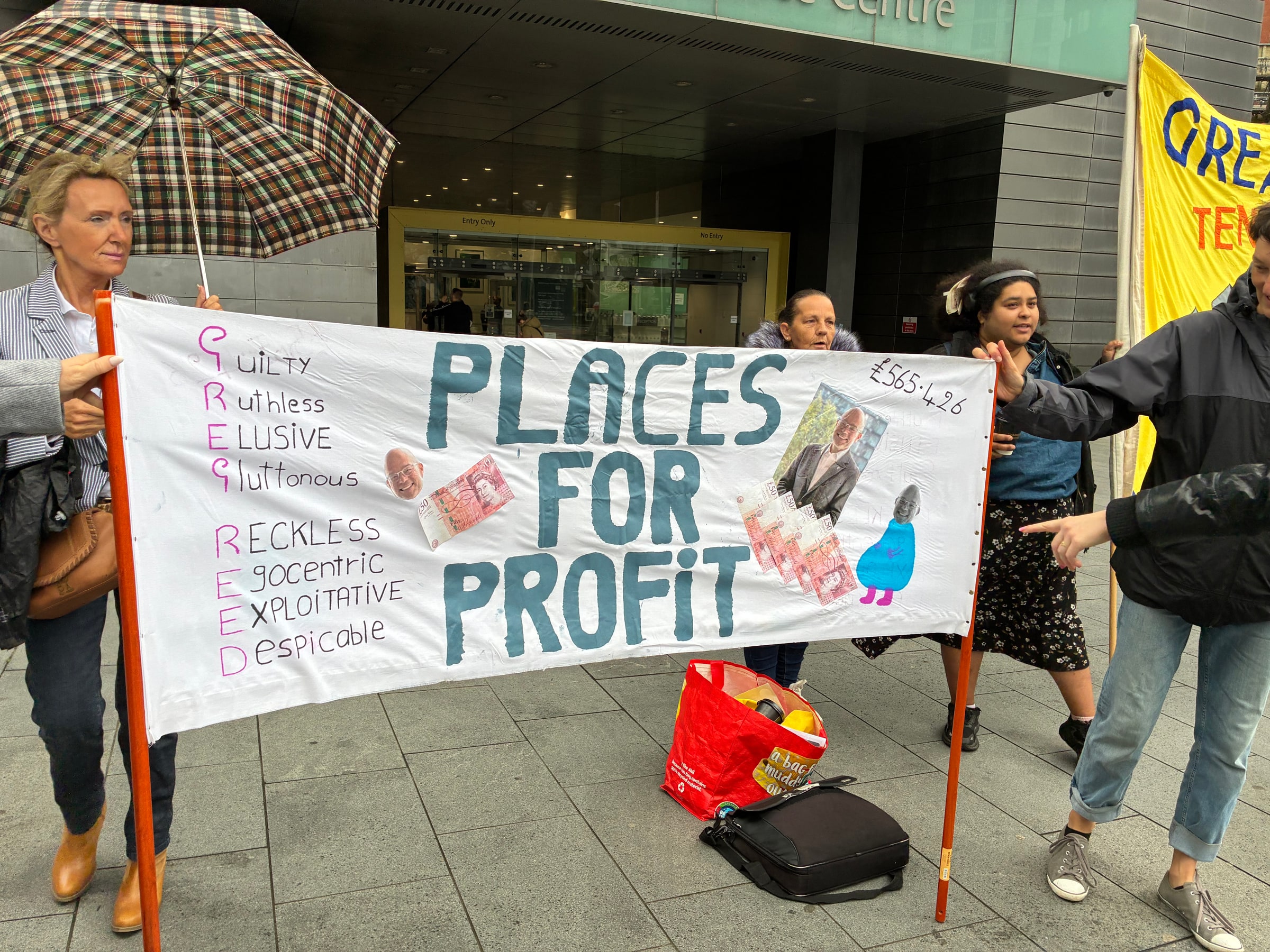
They arrive at the courts with matching T-shirts and a sense of grim determination.
Lined up outside the Manchester Civil Justice Centre, it’s the last hope for a group of tenants from Gilderdale Close in Shaw. For more than 18 months, they’ve been fighting their landlords, the housing association Places for People, after they were informed their rents were due to rise up to forty percent in the next two years.
Now they’re trying to take the company to court.
“We have no choice but to be here,” said Sarah Howarth-Flanagan, 45, who has been leading the tenants’ campaign against PfP. “These are our homes. If they put the rents up to what they want them to be, we will be homeless. Most of us can’t afford £1,200 a month in rent.”
The issue started in May last year, when residents across Gilderdale Close and nearby Napier Street received a letter about their rent increases. For decades, families have been living in these homes believing they were social housing tenants with ‘secure tenancies’, a reduced rent, and access to housing benefits (as opposed to housing allowance, which is paid to those in private rentals).
Now Places for People insist the houses have always been privately rented properties. They intend ultimately to bring the rents back up to market value. For most of the tenants currently living there, which includes pensioners, people with disabilities, and single mums caring for kids with SEND needs, the increase would simply be unaffordable.
“I’ve been looking at caravans, just in case,” Deborah Lowe, one of the residents told the LDRS. Deborah, her partner and three kids moved into the property after a spell of homelessness after their businesses in London went bust during the financial crash. She was under the impression the homes were made available to her based on the council’s points system for families in need. “I always said that house was like a gift from God,” she said. “We were so relieved to be living together again after spending months apart, split across our parents’ houses. Now it feels like the carpet’s been pulled out from under our feet. It’s like I’m back in the exact same position, except I’m a lot older now, and the housing situation is so much worse. If they win and put up the rents, I really don’t know what will happen to me.”
PfP have suspended the increases for the last year and a half but the residents have no assurances that things will stay that way.
Their last hope is the legal system. If they can prove they are social housing tenants, their rent increases will be capped according to government regulations – but first, they need permission from the courts to take the case forward.
Earlier this year, a written request for a judicial review into the matter was turned down by High Court Judge Mr Ockelton, who didn’t believe their case was strong enough for a full hearing. On Thursday, September 17, the tenants arrived at the Manchester Civil Justice Centre on Bridge Street to attend a reconsideration hearing – a kind of appeal of the decision.
Tenants were shaking with anxiety as they filed into the back row of the courtroom.
The case centres on just one of the tenants, Pauline Mason, 74, who has lived on Gilderdale Close since 1992
Pauline moved into the property as a result of a ‘house swap’, exchanging her council house in Royton for one owned by Places for People.
“If I’d ever thought I was swapping a council house for a private rental, I never would have taken it,” she told the LDRS. Pauline was left disabled after a fall that ‘shunted her spine through her neck’. Her house has been altered with specialist equipment that makes it easier for her to remain independent. And with 7,500 families on Oldham’s housing register, and a distinct shortage of disability-accessible homes across Greater Manchester, finding a suitable new living space for her would be extremely difficult if she loses her home.
“The last 18 months have been so full of anxiety for me,” she said. “I’ve only got a few years left in me, and I don’t know how I’d cope with having to move.”
But the case is not a straightforward one.
Regulations around social housing are fraught with grey zones and contradictions, according to housing campaigners the Greater Manchester Tenants Union. When most of the contracts were drawn up for Gilderdale and Napier, there wasn’t a legal definition of ‘social housing’ – that came about in 2009.
Legal representatives for Places For People argued to the judge Mr Pearce, that the homes built by Britnor in the nineties weren’t constructed with public money, and so don’t meet the definition of social housing. They maintain that Places For People, which started as the social landlords North British Housing Association, has always treated the properties as market rent homes – but offered reduced rents during difficult periods.
Greg Reed, the firm’s CEO, previously noted in a letter to Oldham Council that the resident’s tenancies ‘may have given the impression’ that the properties are social housing tenancies, but weren’t. The letter, which was referenced during the hearing, went on: “This is because the tenancies contain most of the benefits of social housing tenancies such as the right to swap homes and succession rights. lmportantly, however, the rent review provisions are those of a non-social housing type”.
Representing Pauline’s case, Mr Daniel Grütters argued the home wasn’t advertised on the open market, and the tenancies include references to regulatory bodies responsible for overseeing social housing at the time it was drawn up. Tenants were treated like social housing tenants, and neighbours on the same street were allocated housing by the council as victims of domestic abuse, meaning the houses meet the definition of social housing as homes ‘made available to those whose needs are not met by homes available on the public market’.
After a short deliberation, his Honour Judge Mr Pearce ultimately said he agreed with some of Mr Ockleton’s assessments of the case.
“I see formidable points made on the defendant’s part that ultimately may be successful,” he said, then added: “But having heard the submission on the claimant’s side, they show suggestions there’s an arguable case. I therefore grant the claimants application.”
Tenants shared they were ‘ecstatic’ at the decision, which will see the case receive a full-day hearing at a later date.
Commenting on the situation, Ben Clay, a representative for the Greater Manchester Tenant’s Union said: “This shows that despite the difficulties, there is still scope within the legal system for ordinary people to hold these massive organisations to account. Places for People is one of the largest housing associations in the UK. They’ve got charitable status and recourse to powers within the local authority because of the supposedly social-minded landlording they do. But in this case they’re putting maximising profit in front of the social missions that are expected of them.
“This is also a political issue. After decades of eroding social housing regulations by successive governments, the system is riddled with loopholes that could be exploited. This sets a dangerous precedent of housing associations attempting to privatise social housing stock.”
Places for People were contacted for comment. A spokesperson said: “Due to the nature of this being an active legal proceeding, we can’t comment on the situation at this time.”